Tuesday, July 24, 2012
ACEC California Congratulates Caltrans and San Francisco County for Accelerated Schedule and Innovation on Presidio Parkway Project Issues
he Board of Directors of the American Council of Engineering Companies, California (ACEC California) issued a Resolution this week congratulating and applauding Caltrans and the San Francisco County Transportation Authority (SFCTA) as the driving forces behind the successful $2 billion Presidio Parkway project, which is creating a dramatically safer southern approach to the Golden Gate Bridge in San Francisco.
“Our board recognizes that both Caltrans and SFCTA chose an innovative path in approaching this tremendous engineering feat, and we applaud them for having the foresight and courage to employ California’s landmark public-private partnership (P3) law to finance the project, speed project delivery, ensure long term safety and maintenance and dramatically reduce financial risks to the general public,” said Paul Meyer, executive director of ACEC California.
The Resolution, which was recently unanimously approved by the 60 member Board of Directors of ACEC California, also acknowledged the engineering and land surveying, construction management and other businesses, which created jobs in California and helped make the project a success.


Tuesday, July 17, 2012
ACEC California Welcomes Central Valley EIR for High Speed Rail
SACRAMENTO, CA – July 17, 2012 – The American Council of Engineering Companies, California (ACEC California) today welcomed the timely release of the Environmental Impact Report (EIR) covering the Fresno to Bakersfield section of the proposed high speed rail system and also encouraged Governor Jerry Brown to reintroduce his proposal aimed at protecting the rail project from delaying tactics caused by abuse of the CEQA process.
“On July 6, through a historic vote, California legislators proved the state’s leadership and eagerness to move forward and create the first high-speed rail system in the nation. This week’s release of the EIR for the Fresno to Bakersfield section marks an important milestone in moving the project forward and creating a clear path towards improving California’s transportation infrastructure,” said Paul Meyer, executive director of ACEC California.
Meyer added that even though the project is essential to the state’s futurelivelihood, the state is taking the necessary steps to make sure the vital project conforms to environmental requirements by following the EIR process to the letter. “We have full faith in the EIR process and we encourage Governor Brown to bring back his proposal to protect the high speed rail from frivolous litigation and abuses of the CEQA process by litigants seeking to slow down this vital project,” Meyer said.
“The state’s business, labor, transportation and construction industries are poised to get to work, especially in the state’s Central Valley, which has unemployment rates as high as 15%. The huge number of jobs – 100,000 expected – will not only improve the lives of thousands of Californians and improve the economy now, but the tax revenues generated by new jobs will be help bolster California’s finances,” Meyer concluded.
Monday, July 9, 2012
Buffett’s time bomb ticks louder in California
What Warren Buffett refers to as “the ticking time bomb”--the crisis in public sector pensions--is a constant and unrelenting threat to California taxpayers.
What is clear is that, as many observers have noted (including Mr. Buffett), the status quo with public pensions is utterly unsustainable. California’s cost of public employee pay and benefits have increased 65 percent over the last 10 years. Experts estimate that the unfunded pension liability for California’s public employees runs into the hundreds of billions of dollars.
CNN/Time commentator Fareed Zakaria makes a strong contribution to the whole debate here.
We are all learning to do more with less; and that should include public sector workers.
Voters’ understanding of the issue has simply skyrocketed. Hopefully, last month’s astonishing, landslide votes in San Jose and San Diego approving substantial public employee pension reform will trigger more real reform throughout the state.
Friday, July 6, 2012
ACEC California Supports CA Legislature’s Water Bond Decision (AB 1422)
SACRAMENTO, CA – July 6, 2012 – The American Council of Engineering Companies, California (ACEC California) today supported the California Legislature’s decision to postpone for two years a statewide vote on the proposed $11 billion water bond. Yesterday both the State Assembly and the State Senate voted to approve AB 1422, which pushes a decision originally scheduled for this November to the November 2014 ballot.
“The need to improve the state’s water infrastructure is clearly there but, practically speaking, delaying the decision on whether to issue those bondsmakes complete sense in the current fiscal environment. We applaud the Assembly and Senate for their pragmatic, bipartisan approach this week and look forward to working with local and state officials and many other organizations over the next two years as we help to educate Californians on the need to dramatically improve California’s water supply,” said Paul Meyer, executive director of ACEC California.
Tuesday, June 26, 2012
ACEC California Honor Award Winner: URS Corporation for the I-5 Gateway
 In late 2010, the Orange County Transportation Authority (OCTA), Caltrans, and the community of Buena Park celebrated the completion of the I-5 Gateway Project. The completed portion of the freeway within the two-mile project limits has resulted in a 12-lane facility with a carpool lane, four mixed-use lanes and an auxiliary lane in each direction of the I-5.
Friday, June 8, 2012
ACEC California Honor Award Winner: T.Y. Lin International for the Harbor Drive Pedestrian Bridge
• $27-million
• 354-ft long
• 34 Individual suspenders attached to the main cable support the 20 ft wide deck from the top of the railing at one edge of the deck only.
• Owner: Centre City Development Corp., San Diego
• General Contractor: Reyes Construction, National City
• Construction Management/Lead Engineer: T.Y. Lin International, National City
• Architect: Safdie Rabines Architects, San Diego
• Civil Engineer: David Evans and Associates, San Diego
 Completed in March 2011, the bridge is a graceful single‐cable self‐anchored suspension bridge with a single inclined pylon and a curved deck suspended only along the inside edge. The pylon itself is inclined at a 60o angle and leans over the deck to support the single pair of suspension cables. As one of the longest self‐anchored, suspension bridges in the world, the iconic Harbor Drive Pedestrian Bridge serves as a southern gateway to downtown San Diego and fulfills the City’s 100‐year vision to link two of its important regional assets: Balboa Park and San Diego Bay.

 Completed in March 2011, the bridge is a graceful single‐cable self‐anchored suspension bridge with a single inclined pylon and a curved deck suspended only along the inside edge. The pylon itself is inclined at a 60o angle and leans over the deck to support the single pair of suspension cables. As one of the longest self‐anchored, suspension bridges in the world, the iconic Harbor Drive Pedestrian Bridge serves as a southern gateway to downtown San Diego and fulfills the City’s 100‐year vision to link two of its important regional assets: Balboa Park and San Diego Bay.

Monday, June 4, 2012
ACEC California Honor Award Winner: SSFM International/Moffatt & Nichol Joint Venture for the Submarine Drive-In Magnetic Silencing Facility
 The joint venture team of SSFM International/Moffatt & Nichol was contracted by U.S. Navy, NAVFAC Hawaii, to design a new non-magnetic concrete drive-in magnetic silencing facility (or a deperming or demagnetizing pier). This facility is part the U.S. Navy's long term mission planning and will support our naval forces, today and into the future. This project was delivered on time and on budget.

Tuesday, May 15, 2012
Governor Brown is on Right Track with Budget Proposal but Much More Can (and Should) be Accomplished
Sacramento, CA – May 15, 2012 – The American Council of Engineering Companies of California (ACEC California) today applauded Governor Brown for his willingness in his just released May Revise to address a significant chronic problem in the state’s budget deficit.
“In his May Revise proposal, the Governor has taken the first real steps in many years towards addressing Caltrans’ overstaffing and workflow issues in an era when there are few resources and even fewer projects to support such a huge department. We applaud Governor Brown for proposing some cuts and opening the door to a full discussion of the issue,” said Paul Meyer, executive director of ACEC California. “There is no doubt that the state can and should do much more,” he added.
Both the bipartisan Legislative Analysts Office (LAO) and the State Auditor have previously recommended that the state can make meaningful savings at Caltrans--money which the state could put to better use in actually rebuilding its crumbling infrastructure. The LAO, for example, has concluded that Caltrans is way overstaffed and recommended cutting Caltrans staff by 1,500 positions–for a savings of approximately $200 million per year. That proposed reduction would be more than 4.5 times the size of the Governor’s proposal.
Caltrans management itself–-faced with the certainty of a declining federal funding and the wrap up of a past bond fund--has also recognized that the department needs to shift more of its engineering work to the private sector in order to better manage project and personnel workload. Management last year asked to be able to contract up to 20 percent of its workload to the private sector instead of the 10 percent historically contracted out. Governor Brown’s proposal will result in Caltrans being able to contract out just 11 percent of its work.
Caltrans today is actually an anomaly. Nationwide state departments of transportation (DOTs) use private engineering firms on average for more than 50 per cent of their workload. DOTs realize that with a private firm after a project is satisfactorily finished, the state has no further financial obligations—such as public employee pensions and lifetime healthcare.
In addition, the LAO and State Auditor have also pointed to systemic inefficiencies in Caltrans’ operations. Until addressed with meaningful reforms, these will continue to hamper the department’s ability to accurately account for project costs and limit its efficient operation.
“The Governor is certainly on the right track and our organization is heartened to see him addressing important issues for the good of the State and all of its citizens. We support him in this endeavor and assure him that the private engineering sector within California stands ready to help should he choose to pursue these additional opportunities to make Caltrans as efficient and cost effective as possible,” Meyer concluded.
Tuesday, May 8, 2012
ACEC California Honor Award Winner: RBF Consulting for the Camp Pendleton Seawater Desalination Feasibility Study
RBF prepared a comprehensive Feasibility Study for San
 Diego County Water Authority (SDCWA), which evaluated numerous alternatives including various sites, screened and subsurface intake methods, brine discharge options, and conveyance pipeline alignments for a proposed 150 MGD Camp Pendleton Seawater
Desalination Project. The Study successfully identified a preferred siting option, and recommended such innovations as the Deep Infiltration Gallery intake, the deep seawater screened intake, and the dual-use pipe-in-pipe intake/discharge configuration. RBF also coordinated extensively with the SDCWA, the U.S. Marine Corps and regulatory agencies on the project. The Camp Pendleton Seawater Desalination Project is continuing with the next phase, for which RBF is currently providing professional services. The next phase of the project consists of onshore and offshore technical studies.
 The Water Authority works through its 24 member agencies to provide a safe, reliable water supply to support the region’s $186 billion economy and the quality of life of 3.1 million residents.


Thursday, May 3, 2012
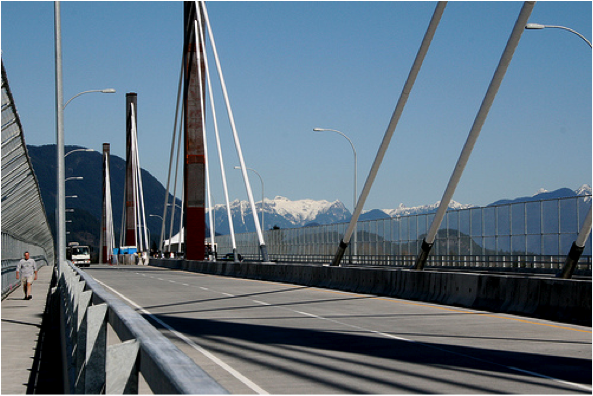
ACEC California Honor Award Winner: International Bridge Technologies, Inc. for the Coast Meridian Overpass
• $132 Million Construction Cost
• The structure is 580 m (1,902 ft) long with six spans of 102.5 m (336 ft), 125 m (410 ft), 110 m (360 ft), 125 m (410 ft), 71.4 m (234 ft), and 46.5 m (152 ft). The bridge is supported on multi-column reinforced concrete bents and 2 m (6.5 ft) diameter piles.
• More than 4,500 tonnes of steel was used to build the bridge superstructure
 International Bridge Technologies was contracted by SNC Lavalin Pacific Constructors, for the City of Port Coquitlam British Columbia, as the prime consultant to design this unique 1900’ long structure crossing a major rail yard. A one-of-a- kind cable supported structure was designed, providing an efficient structure that reduced costs and construction duration, and has become a iconic bridge for the city.
The Coast Meridian Overpass follows the alignment of Coast Meridian Road and serves as a critical transportation link between the north and south of Port Coquitlam, British Columbia. It includes a new structure over the Canada Pacific Railway yard and Lougheed Highway. The overpass carries four traffic lanes, a central median divider, bicycle lanes in both directions, and a sidewalk on the west side. The 23.8 m (78 ft) wide superstructure consists of twin steel box girders connected with floor beams and composite precast concrete deck panels with a reinforced concrete overlay. It is supported by a central plane of stay cables anchored in steel pylons within the median.
Launching operations were success-fully executed and resulted in no unanticipated closures of the railway yard. Construction was completed on schedule; and the bridge opened in March of 2010, completing a vital link for the community.


Friday, April 13, 2012
ACEC California Honor Award Winner: Degenkolb Engineers for Stanford Law School, William H. Neukom Building
Project Facts:
• 65,000 SF building
• $20 million project
• Equivalent of a LEED Silver Certification
• Design: Ennead Architects
• Design Team Leaders: Richard Olcott and Don Weinreich
• Construction Manager: Dome Construction Corporation

The building, named after Stanford law alum and SF Giants Managing General Partner, Bill Neukom, sets a new standard for collaborative, integrated education. Building features include a towering rotunda that echoes the campus’s main entry way as well as a faculty garden, informal meeting spaces, faculty offices, student lounges, and the Mills Legal Clinic.
The design team, led by New York based Ennead Architects, included Degenkolb, MKThink, Cheryl Barton, Taylor Engineering, The Engineering Enterprise, Wilsey Ham, and Atelier Ten. Dome Construction served as general contractor.

The building reflects the university’s sustainability initiative and satisfies the equivalent of a LEED Gold Certification by meeting key sustainability requirements in the areas of site planning; water management; energy use; materials, resources, and waste; indoor environmental quality; and innovation and design.
Thursday, April 5, 2012
ACEC California Comments on Revised Business Plan for High Speed Rail
The American Council of Engineering Companies of California applauds Governor Brown for causing the creation of the California High-Speed Rail Program Draft Revised 2012 Business Plan and recommends that the California High Speed Rail Authority move the project forward by voting to approve the Revised Plan at its April 12 meeting.
The revised plan creates a more practical, less expensive path to the realization of the goal of creating a world-class, high-speed rail system linking the state, which we believe is an essential investment in California’s future.
In seeking revisions to the original plan, the Governor has paved the way for high-speed rail to be built better, faster and cheaper while also creating quality jobs for Californians. ACEC California commend Governor Brown for his diligence on behalf of the state.
Paul J. Meyer
Executive Director
American Council of Engineering Companies of California
1303 J Street, Suite 450
Sacramento, CA 95814
916-340-6305 Direct
916-441-7991 General
916-441-6312 Fax
pmeyer@acec-ca.org
www.acec-ca.org
Professional engineers and surveyors dedicated to building a better California.
Thursday, March 29, 2012
ACEC California Honor Award Winner: Biggs Cardosa Associates, Inc. for BNSF Railroad Underpass at G Street

This $18 million project had a “finished” look earlier than expected when the paving schedule was moved up to October to beat the early winter storm that dumped an inch of rain on the city.
Biggs Cardosa was contracted by the City of Merced as the prime consultant to design the City’s first grade separation at the intersection of Burlington

Northern and Santa Fe Railway Company (BNSF) line and G Street. In an innovative design-build relationship, Biggs Cardosa designed an underpass to BNSF standards so that BNSF could serve as contractor, avoiding the need to build a shoofly for the duration of construction and thereby saving millions of dollars and shortening the project’s length by six months. The project was delivered on time and within budget
Tuesday, March 20, 2012
ACEC California Golden State Award Winner: AECOM and Corgan Associates Design Lean and Green for Sacramento International Airport’s “Big Build”
Project Specifics:
• $1.03 billion project
• 2,400 jobs created
• Largest design-build project in Sacramento County’s history
• Completed 5 months ahead of schedule
• Delivered $60 million under budget
• Manager: AECOM
• Lead design/architect of record: Corgan Associates
Sacramento airport’s Big Build Program was the largest capital improvement program ever undertaken by Sacramento County but the county’s decision to execute a design-build project lead by AECOM resulted in a project delivered ahead of time and under budget.


The team’s innovative building and structural design solutions resulted in lower construction costs for the 700,000 square foot terminal project, while innovative management processes provided timely work authorizations and reduced the construction schedule.
The incorporation of sustainable design ideas provided improved functional design solutions
reduced energy costs, incorporation of historic recycled building materials, on-site power generation, and an anticipated LEED Silver certification for two facilities simultaneously; a first for a U.S. airport.
Wednesday, February 29, 2012
California Engineers Offer Ways to Improve the State’s Infrastructure Grades by 2018.
Sacramento, CA – February 29, 2012 – The exercise of grading California’s public infrastructure can be a useful one, but as today’s 2012 infrastructure report card issued by our colleagues at ASCE clearly indicates, little has been achieved in the six years since the last report card. In fact, California’s grades have hardly improved since 2006.
With the estimated price tag for maintaining our infrastructure doubling in the last six years to $65 billion, the American Council of Engineering Companies (ACEC) of California believes that our state’s policy-makers need new ideas for solutions on how to improve the grades and better leverage our state’s extremely limited capital.
“We must invest more in our infrastructure, but it would be very foolish to simply throw money at our problems without thoughtful and sustainable programs in place. We need to make sure that we get the most bang for the buck,” says Paul Meyer, Executive Director of ACEC California.
ACEC California offers the following suggestions for producing higher grades in four key infrastructure areas by 2018:
Solid Waste (2012 Grade: B)
“Solid waste management is a public health issue, and we should be demanding the highest grade possible,” Meyer states. While the combination of public and private sector waste management programs attained the highest grade for any California infrastructure program in 2012, there was no improvement over the 2006 grade. To improve the grade, the state needs to push policies that incorporate recycled materials in purchasing specifications so that products diverted from landfill, stay out of landfills. We should also re-evaluate program priorities and consider factors such as air quality and wear and tear on our roads, so that mega-landfills are not the only low cost option for solid waste. Valued properly, solid waste programs can even provide the benefit of locally produced, cost effective energy.
Aviation (2012 Grade: C+)
“Airports are micro cities, with much of the same building, pavement and utility infrastructure, yet the cost of infrastructure within an airport is generally much more than what it costs to build in a city. If we can get that cost closer to a municipal cost, we can do more with less,” says Meyer. ACEC California suggests rethinking airport design. The basic concept of an airport requiring very large terminal facilities to support airport operations has been essentially unchanged for decades. Advancements in other market sectors, such as personal rapid transit systems, as well as the broader application of information technology (which can be used in micro energy grids), provide the opportunity to improve the efficiency and operational performance of the terminal, through cross-market integration.
Transportation (2012 Grade: C-)
“California can make a major steps towards a higher grade by creating a leaner, more efficient and modern state department of transportation,” Meyer says. Simple math suggests that Caltrans probably won’t need the 20,000-plus staff it has today to deliver a dramatically scaled-down $2.5 billion transportation program in 2015. It is time to reduce state staffing, assign more resources to actual improvements (rather than administrative costs), authorize municipalities and counties to take more responsibility for project delivery, and make greater use of innovative delivery techniques like public-private partnerships and design-build. These techniques are widely used by other states and nations to speed up project delivery, improve accountability and increase efficiency. ACEC California also recommends that the state reconsider and revamp how it pays for transportation improvements. The current system, which primarily relies on gas tax revenue, is becoming more and more archaic as the popularity of electric, hybrid and non-traditional vehicles rises.
Water (2012 Grade: C)
“With regard to water supply, California is literally living off of the past and the tremendous legacy of the first Governor Brown. However, that is no longer sufficient,” said Meyer. While taking care to protect the environment, California needs more and upgraded water storage and water transport facilities. Public-private partnerships are particularly useful tool for delivering new water supply projects. “Not only is most of our water infrastructure old, it is no longer adequate to meet the needs of our current and projected population. If we are going to provide job opportunities for our young people, if our farmers are going to maintain the productivity of their land, and if our families are going to have enough water to meet their needs, we simply need more water supply.”
Levees/Flood Control (2012 Grade: D)
Today engineers and construction contractors have much better tools and much more knowledge about levees, than we had when most of our levees were originally designed and constructed. Rather than wait for another life threatening disaster to happen, California needs to act now to dedicate an adequate revenue stream to get the job done. Not only is this essential for human safety, it will also be far, far cheaper to fix our levees in advance, than it will be to do major clean up and repair work after a disaster. “Most of California’s levees are old and have lost much of their original strength ability to hold back flood waters. The danger to California homes and businesses and human life is very real,” commented Meyer. “There is no excuse for failing to upgrade and strengthen our levees.”
Ports (2012 Grade: B-)
“California’s ports are a key element in our state’s global competitiveness, and efficient goods movement should be an economic priority for our state. To stay competitive we must have higher grades for our ports,” said Meyer. ACEC California believes we can get there by taking a more cohesive approach to our port structures and their connections with other modes of transportation. The idea is to view our ports as part of a complete transportation system and plan accordingly. We can also improve our ports by making sure that our Harbor Maintenance Tax funds are allocated and used for their intended purpose. Finally, California needs to stay firmly committed to achieving and maintaining in our ports the national infrastructure standard of “State of Good Repair” (SGR).
ACEC California
Friday, January 20, 2012
Reaction to Governor's State of the State
The American Council of Engineering Companies of California commends Governor Brown for articulating in his State of the State speech the importance to our economy of dramatically improving California’s infrastructure. Governor Brown recognizes that major improvements to our water delivery system are vital to California's future, that the high speed rail project with substantial reforms will give our state a much needed economic boost, and that permit streamlining is critical if California is going to meet its ambitious renewable energy goals. ACEC California looks forward to continuing to assist Governor Brown and his administration with achieving its infrastructure goals.
Paul Meyer
Executive Director
ACEC California
Paul Meyer
Executive Director
ACEC California
Wednesday, November 23, 2011
Problems at Caltrans Show Need for State to Reform the Agency
The recent public revelation that a Caltrans employee submitted fabricated safety test results and destroyed testing data for the $6.3 billion Bay Bridge project is deeply troubling.
First and foremost, everyone is rightly concerned about the safety of the new bridge. Fortunately, that employee can no longer engage in such appalling conduct. After The Bee broke the story – following an exhaustive investigation – Caltrans announced it had fired the offending employee and his supervisor. Furthermore, independent experts are now reviewing the integrity of the foundations for the Bay Bridge project.
However, The Bee's findings also raise serious questions about Caltrans itself. The Bee found evidence that Caltrans discovered the employee had falsified reports on other projects after he had tested the foundations of the Bay Bridge project, yet took little action against that employee. Regardless of which official knew what and when, by any standard, such a performance by an organization is unacceptable. At a minimum, such findings demonstrate that at Caltrans there is not nearly enough basic accountability.
In contrast, if a private engineering firm falsified test reports and destroyed data, that firm would almost immediately cease to exist. It would be legally liable for tremendous damages. Its invoices would not be paid. Its reputation would be destroyed. No one would hire the firm.
Today, Caltrans – with 22,000 employees – is so large that it is difficult to properly manage. Indeed, Caltrans is far larger than any other state department of transportation in the nation, including transportation departments with project workloads similar to Caltrans. Whereas Caltrans relies on state employees to do 90 percent of its workload, other state transportation departments use fully accountable engineering firms for an average of 50 percent to 60 percent of their workloads.
Many studies have documented Caltrans' internal problems. For example, the California state auditor found that Caltrans regularly experiences employee cost overruns on projects and fails to keep accurate employee time records, and the state Legislative Analyst's Office conservatively concluded that Caltrans is overstaffed by at least 1,500 employees.
Adopting the LAO's recommendation would free up at least $200 million a year for the hard construction of new transportation projects. It would create thousands of new and badly needed construction jobs.
Freeing up this money for actual construction projects is particularly important, because other sources of funding for transportation are rapidly diminishing. Proposition 1B, the $19 billion bond fund passed in 2006, is running out. The American Recovery and Reinvestment Act federal stimulus funds are winding down. Traditional federal transportation funding is diminishing. And between inflation and an increasing number of people shifting to high-mileage vehicles, the gas tax is losing its ability to generate revenue.
There is no question of the need to dramatically reform and downsize Caltrans. A particularly effective way of accomplishing that – entirely consistent with Gov. Jerry Brown's realignment proposals – is transferring a substantial portion of the state's current transportation funds and authority from Caltrans to local transportation agencies.
Since the mid-1980s, county transportation agencies – often referred to as the "Self-Help Counties" or SHCs – have made many major improvements to our highway and transit systems. Today, more than half of the transportation projects that drivers and transit riders see when they travel actually are sponsored by "Self-Help Counties", not by Caltrans.
The Self-Help Counties have developed a well-earned reputation for speedy, cost-effective delivery of transportation projects and are fully accountable to local voters. The SHCs' revenue comes from local sales tax measures – typically1/2 cent – dedicated to transportation. Those sales tax measures must be approved by two-thirds of the local voters. If the SHCs do not deliver on their promised projects within a reasonable time, the voters will not renew the sales tax measures. It is as simple as that.
Extending the governor's realignment proposal to transportation will greatly improve accountability and efficient project delivery. There is no reason to wait. With our economy hurting, our roads and transit systems in terrible shape, and the public rightly expecting safe transportation facilities, now is the time for realignment.
Eddie Kho, PE
ACEC California President
Tuesday, October 4, 2011
EEA Update: Project Design Consultants Wins 2011 Engineering Excellence Merit Award
Project Design Consultants (PDC) received an Engineering Excellence Award (Merit) for the San Dieguito Wetlands Restoration Project. PDC was contracted by Southern California Edison (SCE), as the prime consultant to provide project management, final grading/dredging plans, flood control coordination, survey/mapping, and permit processing for the restoration of 150 acres of wetlands as part of a 440-acre nature preserve. The preserve is accessible by viewing platforms, a visitor’s center and trail system that is linked from the ocean along the San Dieguito River. The project was an outstanding success by all measure. Southern California Edison (SCE) and other stakeholders are very pleased.
About San Dieguito Wetlands Restoration Project (YouTube Video): http://www.youtube.com/watch?v=n1dTzms5Sck
About San Dieguito Wetlands Restoration Project (YouTube Video): http://www.youtube.com/watch?v=n1dTzms5Sck

Tuesday, September 6, 2011
We Need More American-trained Engineers to Design America's Future
Just before Labor Day, a coalition of 45 companies companies, including Facebook, Intel, Bayer, McKesson, JP Morgan and other big names from the private sector, announced a program to double the number of internships they offer engineering students in 2012.
ACEC California applauds the move, which has a goal of creating 6,500 internships and was announced by the White House as part of the Obama Administration’s goal of increasing the number of engineering students who graduate from U.S. colleges and universities by 10,000 each year. That, in turn, is tied to the Administration’s plans for creating jobs, part of which is to promote engineering disciplines, including infrastructure development which is at the core of what our members – chiefly consulting engineers and land surveyors – are involved in.
It’s a great start, but it’s hardly enough.
Just look at the situation here in California: it has been estimated that each year our higher education system produces 10,000 – or about one sixth -- of the engineers in the U.S. Seventy percent of those graduates hold BS degrees while 20 percent hold a Master’s and the remainder are PhD candidates. Of the 1,000 or so PhD candidates, about 70 percent are foreigners, many of whom return home upon completion of their degree requirement.
Meanwhile, India produces 600,000 engineers per year and China, a staggering one million engineers through its education system. Here in California, we need to at least double the number of engineers we produce here each year to 20,000 just to keep pace and that goes for the U.S. as a whole also.
The U.S. is not alone in being slow to recognize the importance of a strong engineering sector. Earlier this summer, Sir John Parker, head of Britain’s Royal Academy of Engineering, cautioned that the U.K. needs to double its output of qualified engineers if the Cameron government’s goal of “rebalancing the economy” by boosting manufacturing output and jobs was to become reality. Here in the U.S., our manufacturing sector has long been on the wane and part of the reason is a lack of qualified engineers. As Sir John correctly pointed out in his interview with the Financial Times: “If you look at what lies behind the products and services of many companies, from pharmaceuticals to railways, you will find that their creative focus is invariably centred on the art and science of engineering.”
In our industry, we look to engineers to solve huge problems from how to create a safe bridge span, to how high to build a dam and where to establish a wastewater treatment plant. Some solutions are routine, some extraordinary. We honor many projects each year through our Engineering Excellence Awards. Last year’s national winner was a project to design a facility for Southern California onion producer Gills Onions allowing the company to turn onion byproducts into energy to help power a local onion processing plant. Member firm HDR provided that solution.
We also do our bit to promote the sector to students at high schools and colleges throughout the state. Our website has links to resources for students and ACEC California, its local chapters and member firms regularly take outreach to high schools up and down the state. And, in addition to internships and scholarships provided by our national organization, local chapters and member firms, our state Scholarship Foundation provides annual scholarships to engineering students in California.
But we can, and will do more. The Business Council, U.S. Chamber of Commerce, National Association of Manufacturers, American Chemistry Council and the White House have led the way in shining a light on this issue and we hope to intensify the attention on this critical issue.
Friday, August 19, 2011
EEA Update: Kjeldsen, Sinnock & Neudeck, Inc. for the San Joaquin County Flood Contingency Mapping FEMA Pilot

International Bridge Technologies, Inc. received a Small Firm Merit Award for the Pitt River Bridge. International Bridge Technologies, Inc. was contracted by Associated Kjeldsen, Sinnock & Neudeck, Inc., (KSN) contracted with San Joaquin County Office of Emergency Services to provide civil engineering, surveying, and mapping services for the San Joaquin County Flood Contingency Mapping FEMA Pilot Project. KSN collaborated on the development of the standards and procedures used in the preparation of detailed flood contingency mapping and prepared maps for Smith/Weber Tract, Roberts Island, Boggs Tract, and Mossdale Landing Reclamation Districts.
Subscribe to:
Posts (Atom)

 Posts